 Start Free Trial
 What should your Shopify homepage meta description say?
A shopper searching for sustainable clothes reads one line under your homepage link before they tap. Here is what that line should say about your whole store, where Shopify keeps it, and what the homepage has to show next.

Edward Cameron · Founder, Whoosh
6 min read

In short
Your homepage meta description is the short line a shopper reads under your store's link in Google. A product's line describes one thing, but this one speaks for the whole store, so say what you sell and who it is for in the first words. You type it in the Shopify admin under Online Store, then Preferences. Google may show other words from the page, and after the tap the homepage has to show what the line promised.
- The homepage meta description is the line under your store's link in Google, and it describes the whole store rather than one product.
- Type it in the Shopify admin under Online Store, then Preferences, in the Social sharing image and SEO section. Each product has its own separate box.
- Shopify's two guides give different lengths, and Google cuts the line to fit the screen, so put what you sell and who it is for in the first words.
- Google may show other words from your homepage instead. After the tap, the first screen has to show the store the line described.
A shopper searches for sustainable clothes
Someone wants a new jumper, and they would like it to come from a brand that cares how it was made. So they type “sustainable clothing” into Google on their phone, and a column of blue links comes back with a line or two of plain words under each one.
They do not open every link. They read those lines and tap the one that sounds like the kind of store they had in mind.
Some of those links go to a single product. Others go to a store’s front door, the homepage, and the line under a homepage link has a harder job, because it has to describe everything the store sells in a sentence or two.
Shopify’s guide to meta descriptions shows how one brand handles it. Clothing brand Tentree uses its homepage line so that a shopper can see, straight from the search results, that it is a Canadian brand making sustainable clothing for men and women. Somebody who wants eco-friendly clothes gets a reason to tap before they have seen a single jumper.
The same thing happens when a friend mentions your store and someone types its name into Google. The link they want is your homepage, and the line under it is the first description of your store they read. That line is yours to write.
What the homepage line is, and where Shopify keeps it
So where does that line come from? Your homepage carries a short piece of text that nobody browsing your store ever sees. It is written for the shopper who is still in Google, deciding which link to tap. People who build websites call it a meta description.
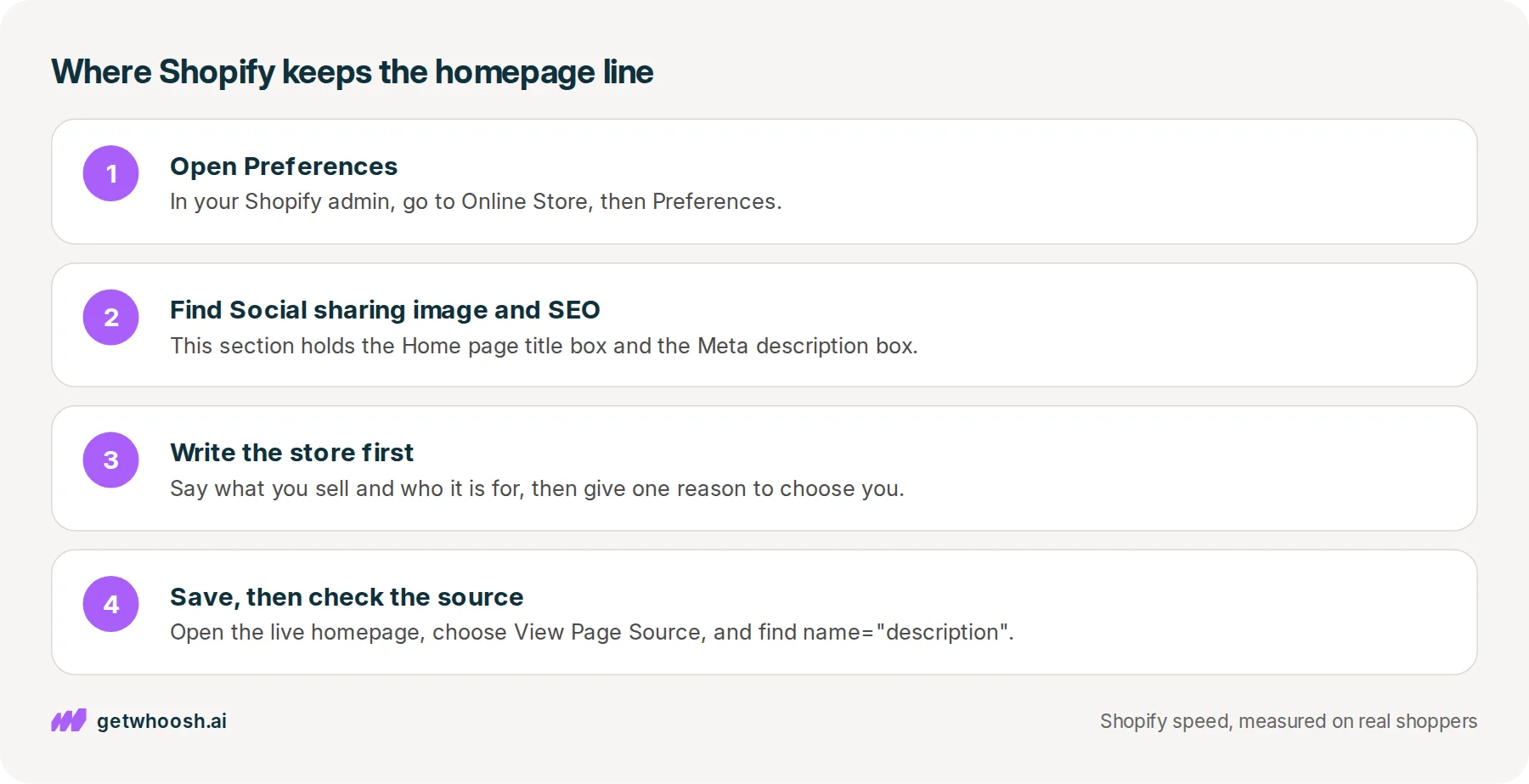
Every page on your store can have one, and Shopify keeps the homepage’s line in a different place from the rest. Shopify’s help page on setting up your store says to go to Online Store, then Preferences, fill in the Home page title and Meta description boxes in the Social sharing image and SEO section, and click Save. The title becomes the blue link, and the meta description is the line under it.
A product page has its own box, in the Search engine listing section at the bottom of each product, and the meta description example post covers the line that goes there. The box under Preferences is the only one that speaks for the whole store.
The same Shopify help page says this line does not change whether a search engine lists your store, but a good one can make a shopper more likely to click through. It also says each page’s title and description should be unique and should describe that page. For the homepage, that page is everything you sell.
Google says the same thing from its side. Google’s guide to the text under search results says to use a description of the whole site on the main home page, and page-level descriptions everywhere else. A jumper’s page gets its own line. The homepage gets the line about the store.
Check your store's real numbers
The free Whoosh audit measures your store on real shopper data, names the scripts in the way, and estimates what the delay is costing. No install, about a minute.
Free. No install. Results in about a minute.
Why the store has to be in the first few words
Here’s the awkward part. Shopify gives you two different lengths, and they do not agree. Shopify’s help page on setting up your store says search engines list only about 140 characters of the line, while Shopify’s guide to meta descriptions recommends about 160 characters.
Google’s guide settles it a different way. It says there is no limit on how long a meta description can be, and that the line in the results is cut to fit the width of the device. So the cut lands wherever the shopper’s phone runs out of room, and neither Shopify number tells you exactly where that is.
What you do control is the order. Put what you sell and who it is for at the front, so the line still makes sense if it stops halfway through. In the Tentree picture, the words that matter to someone searching for sustainable clothes are sustainable clothing for men and women, and a line that opens with words like those has done its job even if the end falls off.
You might be tempted to go the other way. If the line has to cover the whole store, why not list every kind of product you sell? Because Google’s page says descriptions made of long strings of keywords do not give people a clear idea of the page, and are less likely to be shown at all. A shopper reading a run of category names learns less than one reading a plain sentence about what the store is.
Google also keeps the final say on which words appear. The same page says it mostly builds the line from the content on the page, and uses your meta description when it describes the page better than the rest of the content. That gives your homepage line a clear job: describe the store better than anything else on the homepage does.
Write it under Preferences, then make the homepage keep its promise
Let’s start in the admin. Open Online Store, then Preferences, and scroll down to Social sharing image and SEO. Read what is in the Meta description box before you change anything.
If it is empty, Google is left to borrow words from your homepage. If it holds a welcome message or a line about one bestseller, it is not telling a stranger what kind of store this is.
Now write one or two sentences. The first says what you sell and who it is for, in the words someone would type into Google, and the second gives one reason to choose you. Read it back and ask a single question: if the phone cut it halfway, would a stranger searching for your kind of store know they had found one? If the answer is yes, click Save.
Then check that the live homepage is sending it. On a computer, open your homepage, right-click an empty part of it, and choose View Page Source, which shows the raw text your store sent to the browser. Press Ctrl+F, or Cmd+F on a Mac, and search for name="description", then compare the words inside the quotes next to it with the box under Preferences.
If they match, the homepage is set up. If Google still shows other words under your link, nothing on your store is broken, and that is Google choosing text from the page instead. You can stop editing there, because there is nothing more in the admin to change.
So the line did its job and the shopper tapped. What do they get?
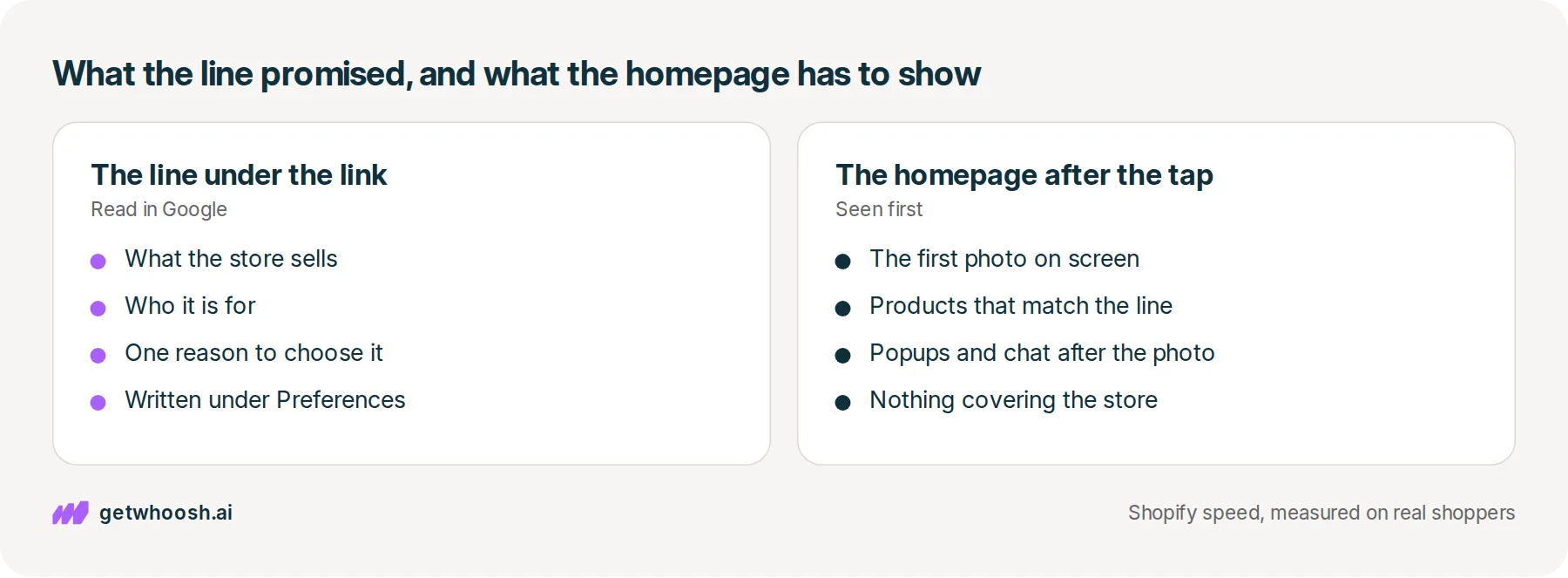
They arrive on your homepage expecting the sustainable clothes they just read about, and if a signup popup or a chat widget gets its turn first, they can be staring at a form over an empty space where the first photo should be. The line promised a store, and the screen is asking for their email.
Whoosh does one job at this moment. Smart App Loading holds your other apps, like that popup, until the first photo on the homepage is on screen, and it does that without removing those apps or copying your theme. Smart App Loading is US$99 a month on the Shopify App Store, with a 7-day free trial. Nakie’s published case study shows the store’s load time falling from 4.8 seconds to 1.35 seconds.
If your popup comes from Klaviyo, the Klaviyo post walks through how to see which arrives first, the photo or the form. Or run our speed check on your homepage and see what reaches the screen before that first photo. When the line under the link and the first screen say the same thing, the shopper who tapped finds the store they were promised.
Questions merchants ask
Is the homepage title the same as the meta description?
No. They are two boxes next to each other under Online Store, then Preferences. The title is the blue link a shopper taps, and the meta description is the line underneath it. Shopify's help page gives the title its own, shorter limit, so keep your store's name and what you sell near the front of it.
Can I use the homepage line on my other pages too?
It is better not to. Shopify's help page says each page's description should be unique and describe that page, and Google's guide to search results text says to use a site-wide description on the homepage and a page-level one everywhere else. Under a jumper's link, a line about the whole store does not tell the shopper which page this is.
I saved a new line. Why does Google still show the old words?
Open your homepage, choose View Page Source, and search for the description line. If it shows your new words, the store is sending them. Google's guide to search results text says it mostly builds the line from the page itself, so the words under the link can still differ from the box you saved.
Do I need to rewrite it every time I add new products?
Only if the kind of store you run changes. The homepage line describes the business, so a new colour of jumper does not need a new line. If you start selling something different enough that the first words no longer describe the store, update the box under Preferences and check the page source again.
Sources (5, checked 6 Oct 2026)
- 1 Shopify Help Center on setting up your store's business settings (help.shopify.com, checked 6 Oct 2026)
- 2 Shopify on how to write meta descriptions (shopify.com, checked 6 Oct 2026)
- 3 Google Search Central on controlling snippets in search results (developers.google.com, checked 6 Oct 2026)
- 4 Whoosh on the Shopify App Store (apps.shopify.com, checked 6 Oct 2026)
- 5 Whoosh case study: how Nakie cut load times from 4.8s to 1.35s (getwhoosh.ai, checked 6 Oct 2026)
The admin path and the 140 character figure come from Shopify's help page on store setup, and the 160 character figure and the Tentree example come from Shopify's guide to meta descriptions. What Google prints comes from Google's page on snippets, and the one store result is Nakie's published case study.
How posts are chosen, sourced, checked and corrected: our editorial policy.
Written by Edward Cameron Founder, Whoosh, Sydney, Australia
Edward Cameron is the founder of Whoosh, the Shopify speed app made in Sydney and on the Shopify App Store since August 2025. He writes here about what slows a Shopify product page and how to check it on your own store.
Keep reading
All posts
Agentic commerce 6 min read
What is a good meta description example for a Shopify product?
A shopper searching for a spatula reads the short line under each Google link before they tap. Here is Shopify's own example of that line, why the first words matter most, and where you type yours.

Agentic commerce 6 min read
What does a meta description generator do for a Shopify product?
Your spatula's Google line is blank, so you try a meta description generator. Here is what it drafts, where Shopify keeps that line, and the one read you do before you save it.

Agentic commerce 6 min read
What does a meta description checker tell you about your Shopify store?
You paste your spatula's link into a meta description checker and get a length score. Here is what that score reads, where Shopify already shows the same line, and why it is not the line Google prints.
